A Pro Se Litigant · Ninth Circuit · §1983

When the Litigant
Has the Library

Frontier AI as civil-rights infrastructure — and what it reveals when it opens the public record

Balu v. Druckman  ·  No. 25-3497  ·  United States Court of Appeals, Ninth Circuit

Scroll

"For the first time in the §1983 era, a pro se plaintiff with a complex civil-rights claim can produce work product that meets the threshold question — without a litigation team. The doctrine has not noticed."

— When the Litigant Has the Library, submitted Stanford Law Review Online, 2026

The dominant frame in AI and civil rights is incomplete.

The scholarship treats AI exclusively as a source of harm. That frame is necessary — but it misses a structural shift happening now, in real federal dockets, with almost no scholarly attention.

I
The Thompson Window
Thompson v. Clark (2022) abrogated decades of §1983 dismissals under now-wrong law. Nairns v. United States confirmed it. The window to revisit those dismissals is narrow, procedurally complex, and closing — and almost no pro se plaintiff knows it exists.
II
What AI Actually Does Now
Deep research agents. Agentic browsers. Million-token context windows. Multi-model orchestration. One pro se litigant, one device, roughly the cost of one hour of associate time — performing work that used to require a litigation team.
III
The Shadow Docket
The N.D. Cal. pro se civil-rights docket is technically public and practically invisible. Hundreds of §1983 dismissals per year. No systematic study. No external check on how doctrine is applied in aggregate. AI can now read it. The law hasn't noticed.
IV
Access Is a Civil-Rights Question
The most significant pro-plaintiff infrastructure since §1988 fee-shifting is being distributed by subscription price and digital literacy — both of which correlate with exactly the demographic distributions civil rights law has spent six decades trying to flatten.

Four documents. Two law reviews. One case.

Everything published or submitted arising from the federal civil-rights appeal — Balu v. Druckman, No. 25-3497, Ninth Circuit.
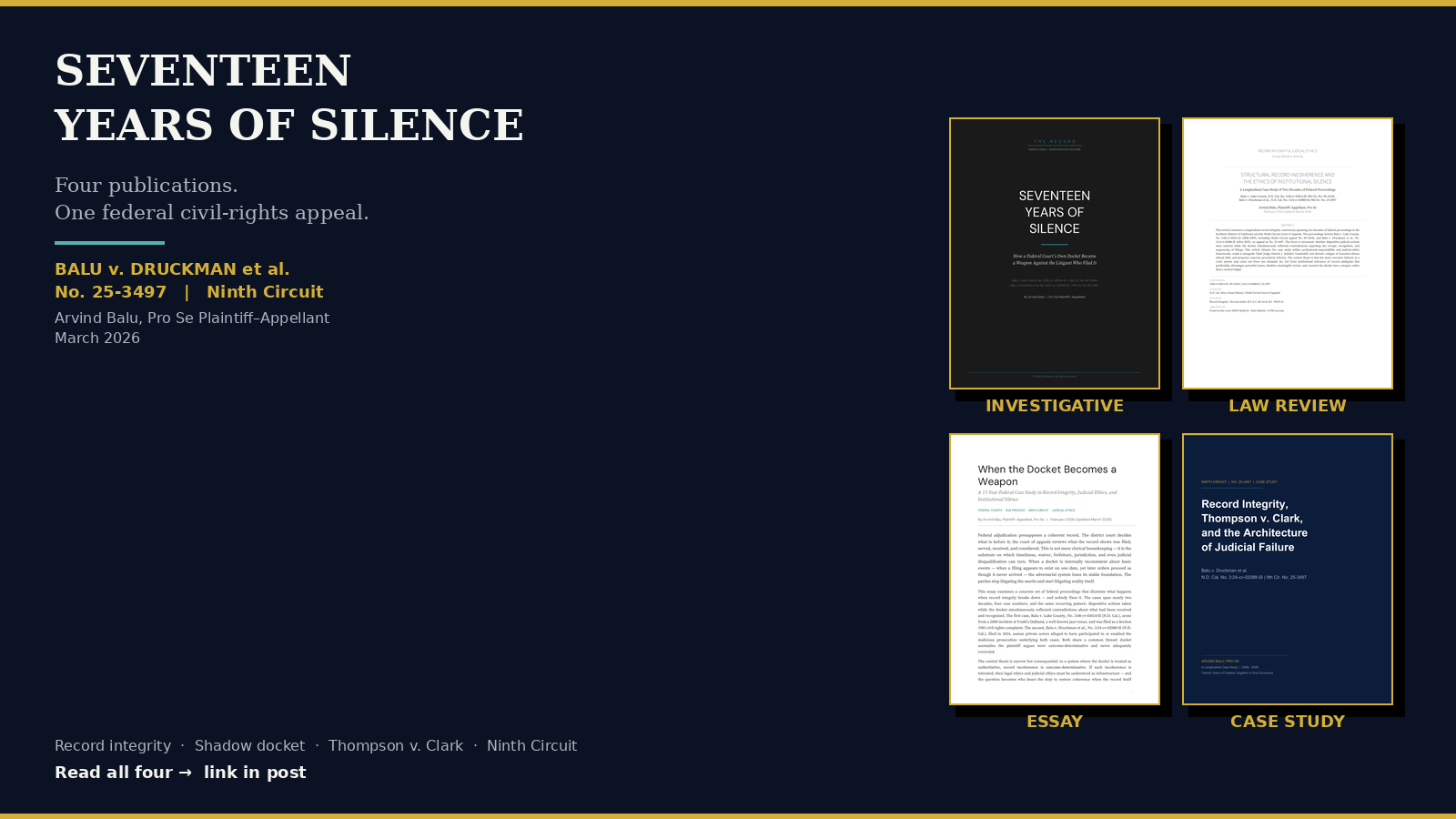
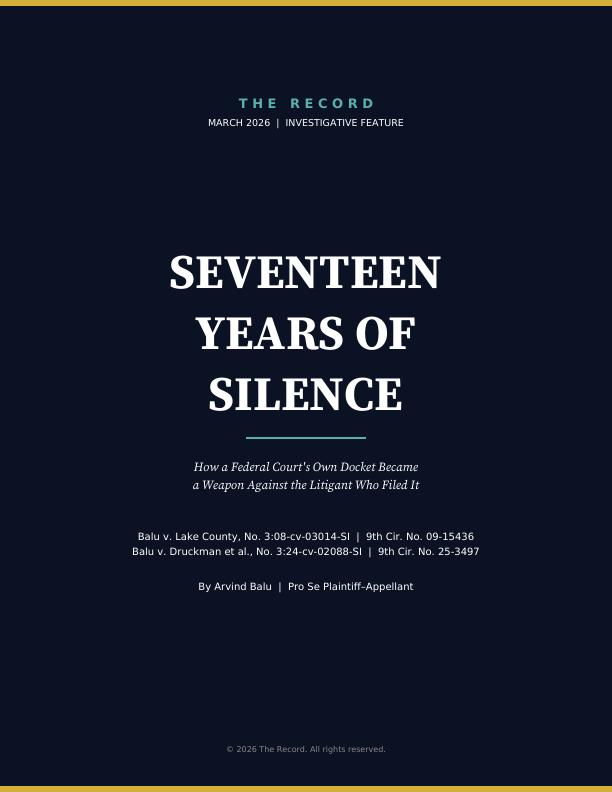
Seventeen Years of Silence — four publications composite
Seventeen Years of Silence cover
Investigative · March 2026

Seventeen Years of Silence

How a Federal Court's Own Docket Became a Weapon Against the Litigant Who Filed It. Balu v. Lake County, No. 09-15436 · Balu v. Druckman, No. 25-3497. Expanded Review Edition.

Read Document
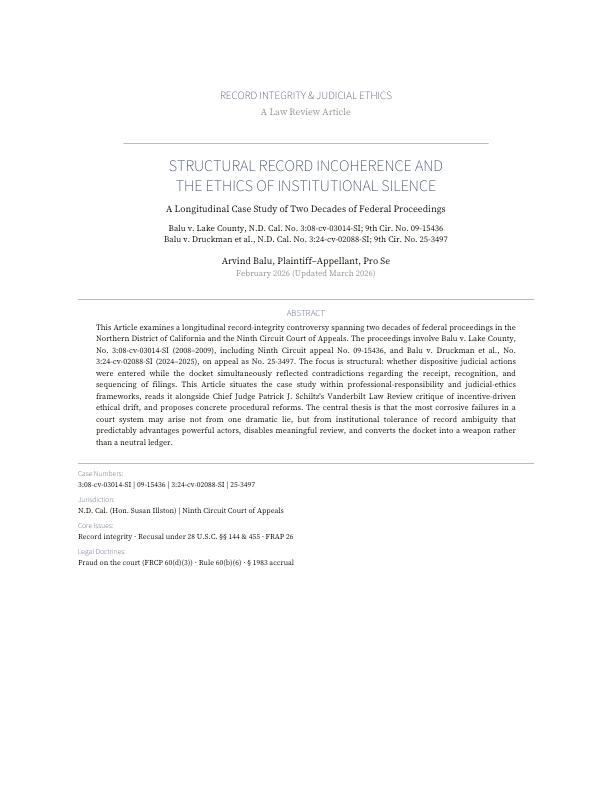
Structural Record Incoherence cover
Law Review Article · February 2026

Structural Record Incoherence and the Ethics of Institutional Silence

A longitudinal case study of two decades of federal proceedings. Examines record integrity, judicial ethics, recusal under 28 U.S.C. §§ 144 & 455, fraud on the court under FRCP 60(d)(3), and Rule 60(b)(6) in the §1983 context.

Read Document
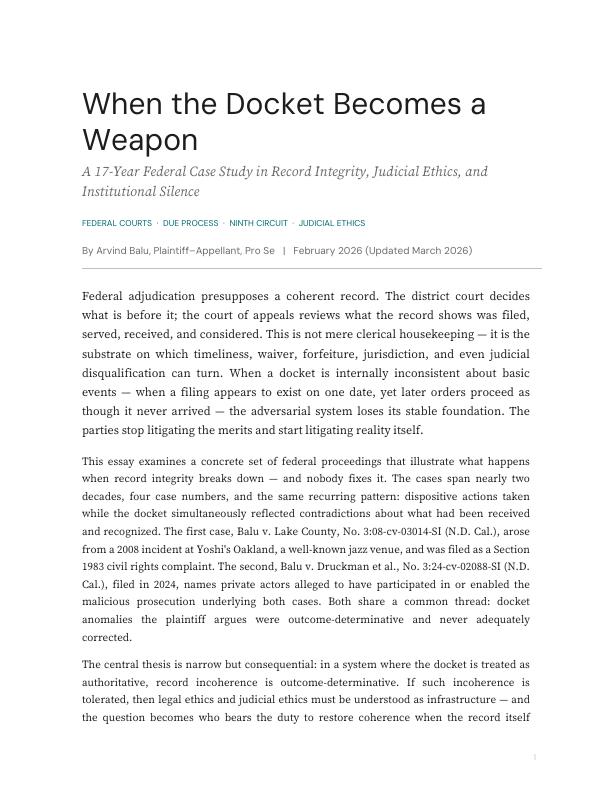
When the Docket Becomes a Weapon cover
Essay · 2026

When the Docket Becomes a Weapon

A 17-Year Federal Case Study in Record Integrity, Judicial Ethics, and Institutional Silence. Examines how a federal docket can be used against the litigant who filed it — through selective omission, incomplete transcription, and misapplication of the standard of review.

Read Document
Case Study cover
Case Study · 2026

Balu v. Druckman: A Longitudinal Case Study

A structured case study of the mechanics of federal proceedings across two decades — N.D. Cal. No. 3:24-cv-02088-SI, Ninth Circuit No. 25-3497 — examining the procedural sequence, record anomalies, and AI-assisted findings now before the appellate court.

Read Document
Stanford
Law Review
Online
"When the Litigant
Has the Library"
Submitted 2026

When the Litigant Has the Library: Frontier AI as Civil-Rights Infrastructure for Pro Se Federal Plaintiffs

Submitted to Stanford Law Review Online Special Collection on Technology, AI, and the Future of Civil Rights. Argues frontier AI functions as civil-rights infrastructure for the unrepresented federal plaintiff — drawing on the live Ninth Circuit appeal as case study.

California
Law Review
Online
"In the Shadows of
the Pro Se Docket"
Submitted July 2026

In the Shadows of the Pro Se Docket: What Artificial Intelligence Reveals When It Opens the Public Record

Submitted to California Law Review Online. Introduces the pro se shadow docket — N.D. Cal. civil-rights cases technically public and practically invisible — and argues AI has fundamentally changed the cost structure of oversight.

The Live Case

Balu v. Druckman

No. 25-3497 · United States Court of Appeals for the Ninth Circuit · Pro Se Appellant

A §1983 civil-rights action arising from malicious prosecution, with associated Monell municipal-liability theories, stemming from a wrongful state prosecution resolved under California Penal Code § 851.8 — the factual-innocence statutory mechanism. Filed in the Northern District of California in 2024. Dismissed in early 2025. Currently pending on appeal.

The case is not offered as an argument on its merits. It is offered as a documented record — time-stamped, docket-anchored — of what frontier AI tools, deployed by a single non-lawyer plaintiff, can now produce against a represented government defendant in real federal litigation.

AI-assisted record review surfaced timestamp inconsistencies, missing cross-referenced documents, and applications of the now-abrogated pre-Thompson favorable-termination standard — findings now before the Ninth Circuit in a pending Rule 60(d)(3) motion.

20+
Years of underlying proceedings
§1983
Civil rights claim, 42 U.S.C.
9th
Circuit — appeal pending